
1. Introduction
Thermal management is the single most critical factor determining the performance, light output quality, and operational lifespan of LED luminaires. While LEDs are highly efficient, approximately 70% of the electrical energy they consume is converted into heat rather than light.
To prevent premature lumen depreciation and color shifting, choosing the right heat sink material is paramount. Today, lighting OEMs and B2B buyers frequently compare Cold Forged Aluminum and Die-Cast Aluminum. This article examines their technical differences and explains why cold forging is becoming the gold standard for high-performance LED fixtures.
2. Thermal Management: Why Material Matters for LEDs
The efficiency of an LED heat sink relies directly on thermal conductivity ($W/m\cdot K$) and structural density.
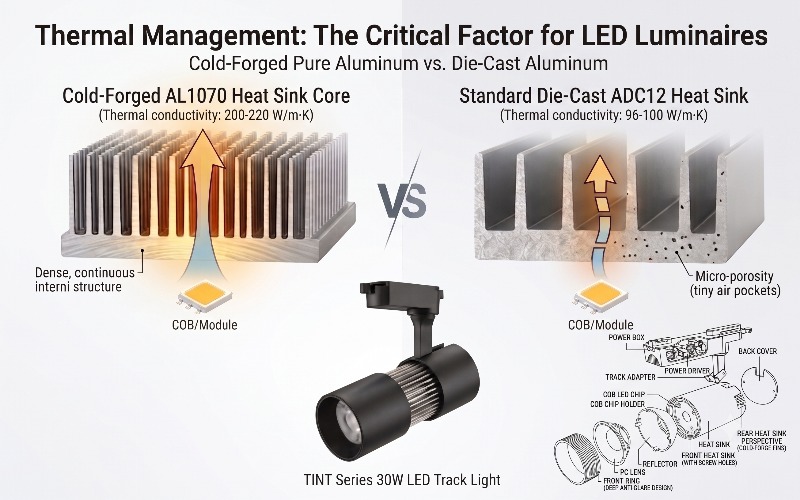
- Superior Thermal Conductivity: Cold forged LED heat sinks are manufactured using pure aluminum alloys (such as AL1070), delivering a thermal conductivity of 200–220 W/m·K. In contrast, standard die-cast aluminum utilizes silicon-rich alloys (ADC12/A380) to facilitate liquid molding, which degrades thermal conductivity to 96–100 W/m·K.
- Zero Micro-Porosity: Liquid metal injection in die-casting creates tiny air pockets (porosity) during rapid cooling, acting as thermal barriers. Cold forging applies high mechanical pressure at room temperature, producing a dense, continuous grain structure that transfers heat away from the LED COB/Module rapidly.
3. Design Freedom vs. Cooling Density
Both manufacturing methods serve specific structural roles in LED fixture design:
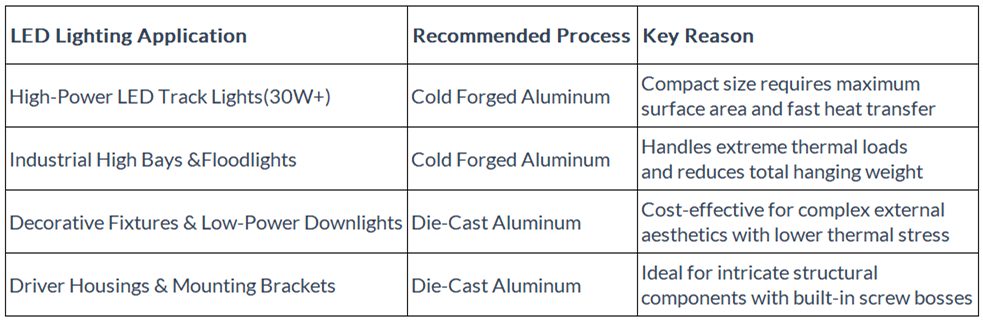
- Cold Forged Heat Sinks (High Density & Light Weight): Cold forging allows for thinner, taller, and more tightly packed pin-fin or plate-fin configurations. This creates a larger surface area for natural convection within compact fixture sizes (e.g., Track Lights and Downlights) while keeping the overall fixture light.
- Die-Cast Housings (Complex Outer Shells): Die-casting excels at creating complex 3D shapes, outer aesthetic housings, integrated driver boxes, and mounting brackets in a single step.
4. Commercial & Supply Chain ROI for LED Brands
For LED lighting manufacturers, distributors, and project contractors, adopting cold forged heat sinks provides significant commercial advantages:
- Reduced Luminaire Size & Shipping Costs: Because cold forged aluminum has double the thermal dissipation efficiency of die-cast aluminum, you can achieve the same thermal performance with a smaller, lighter heat sink. This reduces raw material usage and significantly lowers international logistics costs.
- Lower Junction Temperature & Extended Warranty: Keeping the LED junction temperature (Tj) low directly prevents thermal degradation, allowing brands to offer 5-year to 10-year product warranties with confidence.
- Enhanced Reliability in High-Wattage Applications: High-power LED track lights (30W–50W+), high bays, and outdoor floodlights benefit drastically from cold forging, minimizing field failures and RMA service costs.
5. Selection Guide: When to Choose Which?
💡 Case Study: TINT LED Track Light (30W)
Engineering Thermal Optimization for High-Output Retail Lighting
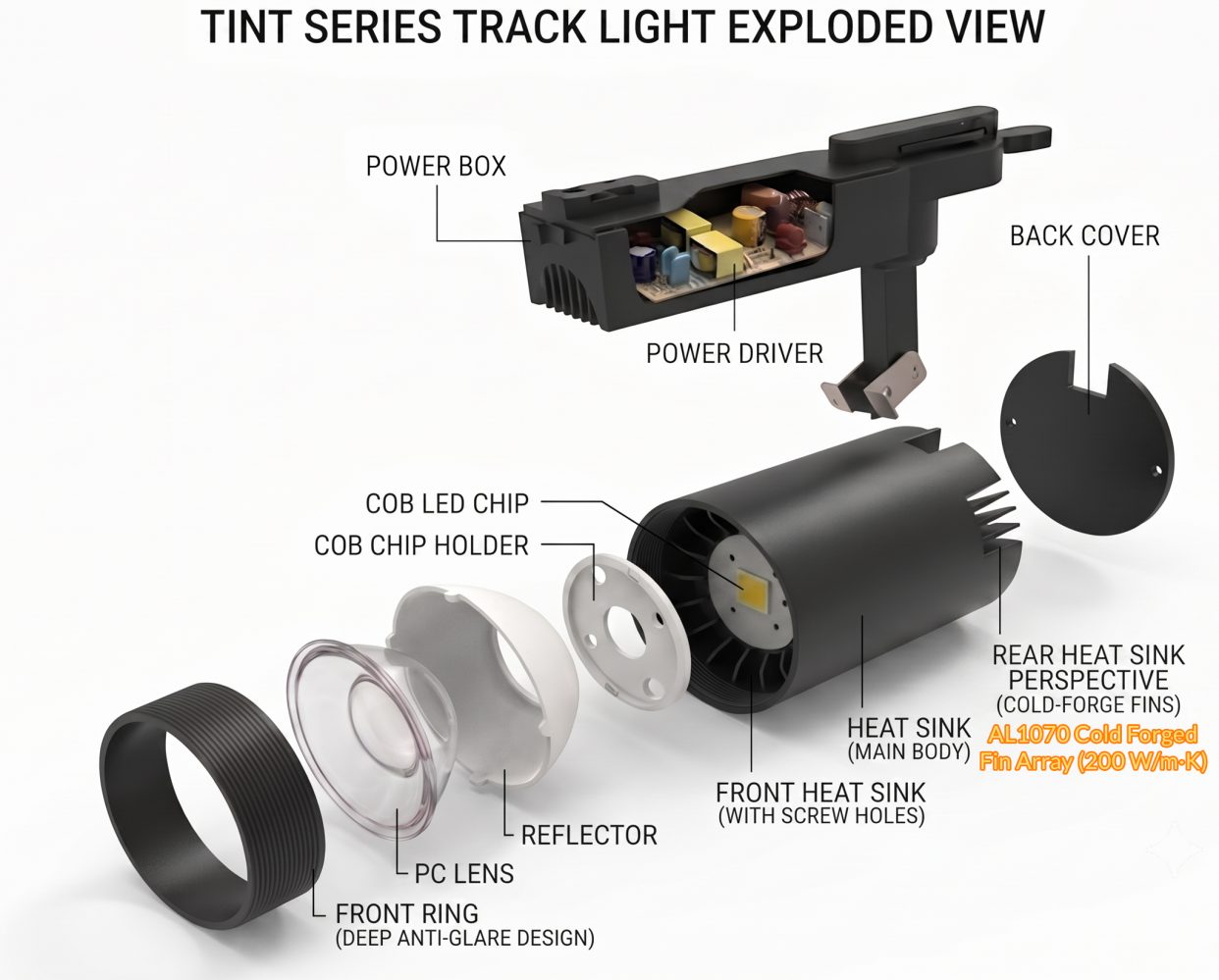
Exploded view showing the AL1070 cold-forged heat sink core integrated into the TINT 30W LED Track Light
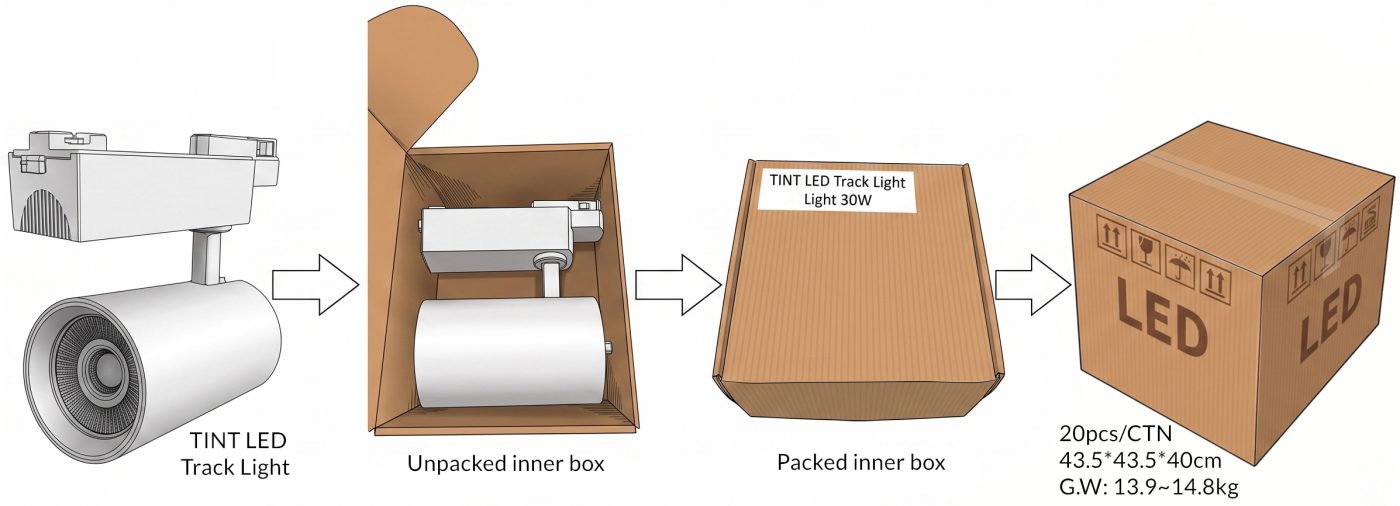
Follow is packaging and assembly.
The Challenge:
Standard 30W LED track lights using traditional die-cast heat sinks often suffer from excessive heat accumulation in compact commercial fixtures. This causes premature lumen depreciation and forces lighting brands to reduce operating wattage or shorten warranty periods.
The Cold-Forging Solution:
By adopting an AL1070 cold-forged aluminum heat sink core for the TINT 30W LED Track Light, our engineering team achieved:
- 50% Faster Heat Dissipation: Thermal conductivity jumped from ~96 W/m·K (die-cast) to 200+ W/m·K.
- Lower Junction Temperature (Tj): Maintained Tj below 75°C even under continuous full-load retail operation.
- 30% Weight Reduction: Enabled a more compact, ultra-dense pin-fin cooling profile while lowering master carton shipping weight (20pcs/CTN, gross weight within 13.9–14.8kg).
- Extended Lifespan: Guaranteed a 50,000-hour operational lifespan backed by an extended 5-year B2B warranty.
6. Call to Action
Optimize Your LED Thermal Performance Today
Looking to upgrade your LED lighting products with high-efficiency thermal solutions? Contact our engineering team to request thermal simulation analysis, custom cold-forged heat sink designs, or instant quotation for your upcoming OEM/ODM lighting projects.